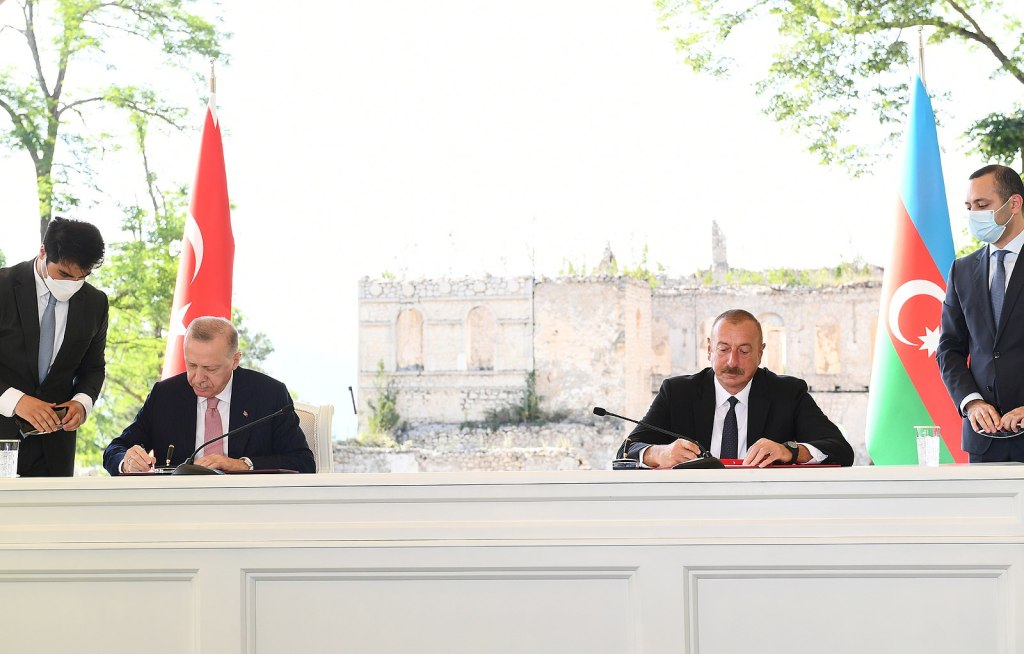
The ongoing geopolitical struggle in Nagorno-Karabakh has reached a turning point in this past week, as a result of a joint declaration issued by Turkish President Recep Erdogan and Azerbaijan President Ilham Aliyev in the recently recaptured city of Shusha. While Americans were reeling from the Presidential election, a territorial war was fought in a fashion that is paradoxically conventional but unorthodox in terms of the use of force in modern statecraft.
In the eyes of many Americans, the business and disputes of the world are seen as something that could be controlled or manipulated with help from the West. With regard to this age-old conflict, the United States has attempted to negotiate amenable terms between Armenia and Azerbaijan as a member of the Organization for Security and Co-operation in Europe’s Minsk Group. Along with Russian and French counterparts, diplomatic missions and humanitarian aid providers have ventured to the disputed regions of Nagorno-Karabakh with the idealistic dream that they could stave off crisis.
Although the national security of the United States may seem quite removed from this international dispute, the ramifications that a wider conflict could have is a direct result of the geopolitical history of the lands that both of these proud societies occupy. While Armenia and Azerbaijan compete for control over the city of Shusha today, just thirty years ago this land was controlled through the Soviet apparatus that had crushed nationalistic and religious identities under the iron fist of totalitarian communism. As a result, Russian President Vladimir Putin must be considered a key member of the audience that was supposed to interpret meaning from the symbolic reaffirmation of Turkic brotherhood that the Shusha Declaration was meant to display.
With regard to Russia, Turkey has attempted to bolster its geopolitical stance with limited success in Libya, Syria, and Egypt in the past decade. While Turkey attempted to provide diplomatic support for the eventually deposed Muslim Brotherhood (Ikhwan) government of Mohammad Morsi, the counterrevolution led by the Egyptian President Abdel Fattah el-Sisi stifled this stratagem. In Syria, Turkey has attempted with perhaps the greatest amount of force of the three conflicts to protect its national interests by suppressing militant Kurdish influences that have long been considered the most viable threat to the general stability of the Turkish state from external forces. In Libya, as a direct result of the toppling of Muammar Gaddafi by Western-backed rebels, a quagmire has emerged wherein proxy armies and mercenaries have effectively transformed that nation into a testing ground for modern tactics of war while spurring a refugee crisis that has embattled the European Union for nearly a decade.
All told, the most recent round of diplomatic showmanship was a display for Turkey in that longstanding rivalry with Russia that will serve to reinforce a feeling of security for the Turkish electorate in the leadership of President Erdogan and his ability to direct geopolitical events in a favorable manner for the Turkish nation. In addition, it serves as vindication for the decades-long buildup of military power by the government of Azerbaijan that has long been a cornerstone of the rationale for continued support of Aliyev’s leadership of that nation.
Control over the city of Shusha is geopolitically important because it is a former Soviet city that has divergent cultural connections to both Armenians and Azeris. It is important to recognize that a critical reason for Armenia’s initial capture of Shusha was a direct result of a politically unauthorized decision in the final days of the Soviet Union to transfer the military equipment necessary to the breakaway Republic of Artsakh and their supporters in Yerevan that ultimately was used to overpower the Azeri position and forcibly exile civilians to Baku in the 1990s.
While I am not in the business of making moral arguments on behalf of either side of the conflict, the important takeaway is that Russia chose not to intervene on behalf of the Armenian cause and that may be as a result of the solid relations that were reaffirmed last week between Azerbaijan and Turkey.
 American Political Theorist