As happened with great frequency throughout the twentieth century, the warring parties in the First Indochina War were bound by political expediency and reinforced by ideological
rigidities to larger or creditor world powers that promised to protect these reliant nations with which collective defensive relations or an alliance treaty had been established. While Chinese nationalists and communists struggled for control of the Chinese mainland, history often remembers how the warring sides briefly joined together to repel the conquering Japanese imperial forces.
Despite an initially inward disposition toward exerting the Chinese position in international affairs, as the Communists took decisive political responsibility for the Chinese mainland, the Vietnamese were approached and strategic alliances were cultivated that solidified DRV access to crucial supply lines. Remarkably, the strategic coherence of this position meant that without political strain or faux pas, Comintern protege Ho Chi Minh was also remaining firmly within the Soviet umbrella of foreign material defensive aid, despite Stalin’s general tendency to avert from the implementation of Communism in colonial nations that he considered inadequately developed to sustain the Marxian timeline of economic progression.
While the diplomatic relationship between the Chinese and Soviets declined with the death of Stalin, the ever-calculating Soviet autocrat recognized the strategic importance that close collaboration between the Chinese and their comrades in the Democratic Republic of Vietnam (DRV) would provide for the advance of Marxist-Leninism within East Asia. In a striking ‘textbook’ example of the normative practice of viewing international relations within the paradigmatic lens that visualizes a sphere of influence as sacredly belonging to another nation, it becomes evident to me that Vietnam’s history as a tributary state to China’s confucian Middle Kingdom emperors was repackaged within the newly-fashioned throes of world revolution to bolster the international prestige of Mao’s newly established regime.
Given the contextual turmoil within East Asia and the world more generally during this
period, it should perhaps come as no surprise that outside powers sought to carve out their
own position in any negotiated settlement of the Vietnamese decolonization settlements. In fact, European intervention in diplomatic proceedings and extraction of wealth from within the region was commonplace during the Chinese century of humiliation, and American usage of two nuclear bombs solidified their position at every important discussion. As China began to project power after quelling the fractious internal situation, numerous international forums provided opportunities for the Communists to engage with the British, Americans, and Soviets, with the purpose to make sense of the regional disorder wrought by French and Japanese incursions into Vietnam. While the British were equally as colonially incorrect as the sorely demoralized French occupiers, Anthony Eden slyly maintained Britain’s role in international proceedings by assuming co-chairmanship of proceedings regarding Vietnam with Soviet Foreign Minister Vyacheslav Molotov. Such a position hardly details the complex reality on the ground, as Chinese and British forces did occupy Vietnam in order to clear out Japanese occupiers at the end of the Second World War.
For a variety of reasons, most of the great powers and regional actors were war-weary
in their initial reactions to the post-World War II vacuum: China was dealing with domestic
instability, but were still generally the most likely to unilaterally escalate their commitment to overt collaboration with the DRV, given their ideological compatibility and shared border which evidently would have shifted the balance of power in favor of the Vietnamese liberation movement considering the shoddy position of the French. Although France was able to retain a semblance of its existing colonial governance apparatus in Vietnam through Vichy occupation, the overwhelming zeitgeist of the era suggested that such improper and unfair relations between states had to be rejected to ensure a future for international peace. Nevertheless, the French resisted this progressive approach and sought to bait the Americans into shouldering the burden of their efforts to retain anti-Communist colonial authority by pitching the unconditional withdrawal of French troops as the equivalent of enabling a power vacuum within which the Communists would prevail in what would ideologically trigger a series of critical blows to the capitalistic world order. Similarly, another acceptable explanation would translate the American subsidization of the French war effort as a quid pro quo in exchange for French cooperation in the collective defense of European opposition to Sovietization. (Lawrence 30)
Historians disagree as to the most acceptable rationale for American support of antiCommunist forces in the “Third World”/Developing World, with varied focus the racialists see racism, the Pan-Americanists see hemispheric unity, the Marxists deny the bankruptcy of their humanistic theology of unfair outcomes by pivoting blame toward the faceless bourgeoisie and the inability of socialistic systems of human organization to compete is blamed upon the interference of those forces of capital.
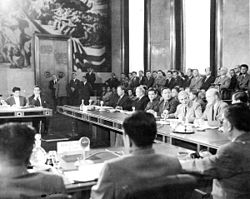
In my understanding, the war’s outcome as it developed at Geneva ended with terms more favorable to the French and Americans than a neutral arbiter would have decided, or than what the Secretary of State John Foster Dulles had seemed to have expected. Even as biased of an anti-Communist as I am, objectively a large subsection of the national sentiment in Vietnam was definitely inundated with the promises of that alternative world order, perhaps due in large part to the lack of quality among existing alternatives who
either were foreign conquerors or otherwise incapable of connecting with the disenchanted Vietnamese people who had sought to establish their own nation but were seemingly entangled within a web of never-ending opposition. Whatever Geneva guaranteed only meant as much as the chief decision makers took it to mean, and when it came to the United States the preservation of international law was something that had to be rejected for the sake of the national interest, elections could not be allowed to validate the popularity of communism and the unification of a communist Vietnam.
Although the Chinese influence on the Vietnamese cause of independence was crucial,
the moral basis of an odds-defying liberation movement seems to outweigh the fact that the situation on the ground in Vietnam could have easily resulted in a more favorable settlement for the indigenous forces, but that their communist affiliations garnered the ire of a burgeoning and mostly undisrupted war machine that was willing to print and spend as much money on the national defense as would preserve the national ethos of American constitutional republicanism, even if that meant abandoning evidence that solidifies the normative regional context of historical ties to a more powerful Chinese aristocracy for the dubious claim that the foreign aid programs to rebuild Europe should also be further supplemented with the necessary defense loans to continue their colonial occupation of Vietnam. Since the United States effectively launched itself into a war with which it had little sympathy for the material claims of its allies but instead carried considerable ramifications for future cooperation in defense of capitalism, it seems to me to have made the greatest individual contribution to changing the outcome as determined through the Berlin and Geneva Conferences of 1954.
 American Political Theorist