
In this response paper, I will analyze the strategic political calculations of Marcus Brutus in William Shakespeare’s canonical work Julius Caesar. In his very first line in Act I Scene II, Marcus Brutus foreshadows Caesar’s impending fate by warning “A soothsayer bids you beware the ides of March.” By echoing the rantings of a seemingly lowly and nameless soothsayer, Brutus sort of transforms himself into a mouthpiece for others. Instead of receiving any blowback from Caesar, the omen is fatefully overlooked by the pompous Caesar by virtue of who had spoken. I believe that Brutus’s usage of a proxy to give warning to the rising emperor is the first example of a way in which he uses his power to shape the course of events.
In this same scene, Brutus also interacts in a contentious dynamic with fellow conspirator Cassius. During their conversation, the two draw each other closer by affirming their allegiance to one another and simultaneously coaxing one another with verbal barbs. In modernity, the art of rhetorical sparring continues to draw political interests toward cooperative competition that is usually settled via compromise, pork barrel spending, or coalition building. In the case of ancient Rome, however, the most noble means of cutting a political movement down to size was not via backroom deals and severance packages but through bloody assassination. Marcus Brutus thus decides to follow through with this murderous plan because he calculates that his actions are necessary to protect Rome from experiencing tyrannical rule. In his own words, Brutus “loves the name of honor more than [he] fears death.”
Brutus’s usage of a proxy to give warning to the rising emperor is the first example of a way in which he uses his power to shape the course of events.
I think that with a contemporary view, the concept of honor in politics has been vastly diminished. However, the reason for Brutus’s desire to embody virtue comes from both ancestral and societal pressures. In Act II Scene I, Marcus Brutus explains that he descends from Romans who drove the power-hungry Tarquins from the city when they sought to expand their power in a way very reminiscent of Caesar’s rise. Livy’s “History of Rome” is a great read for a further explanation of the personal significance that this event has for any subtextual reading of the play, given that the leader in this post-Tarquin era is conveniently also named Brutus. My point is that Brutus arguably derives his power to kill Caesar from his aristocratic lineage that has already proven their willingness to protect the Roman polity, and that Shakespeare almost certainly made that literary allusion on purpose.
When it comes to examining some of the shortcomings of Marcus Brutus’s political strategy, one pertinent reason for his actions may very well be his desire to honor his familial legacy. Cassius uses this decision making bias to again draw Brutus toward his regicidal conspiracy, by alluding to a “great ancestor” named Aeneas that they supposedly shared. By doing so, they are again drawn further together in a sort of fraternal jockeying that causes Brutus to lay bare his naked ambition, seen clearly when he laments to Cassius “How I have thought of this and of these days.” This is his moment to garnish glory in the polity, and Brutus coyly accepts his role in the plot by following the order to speak with Casca.
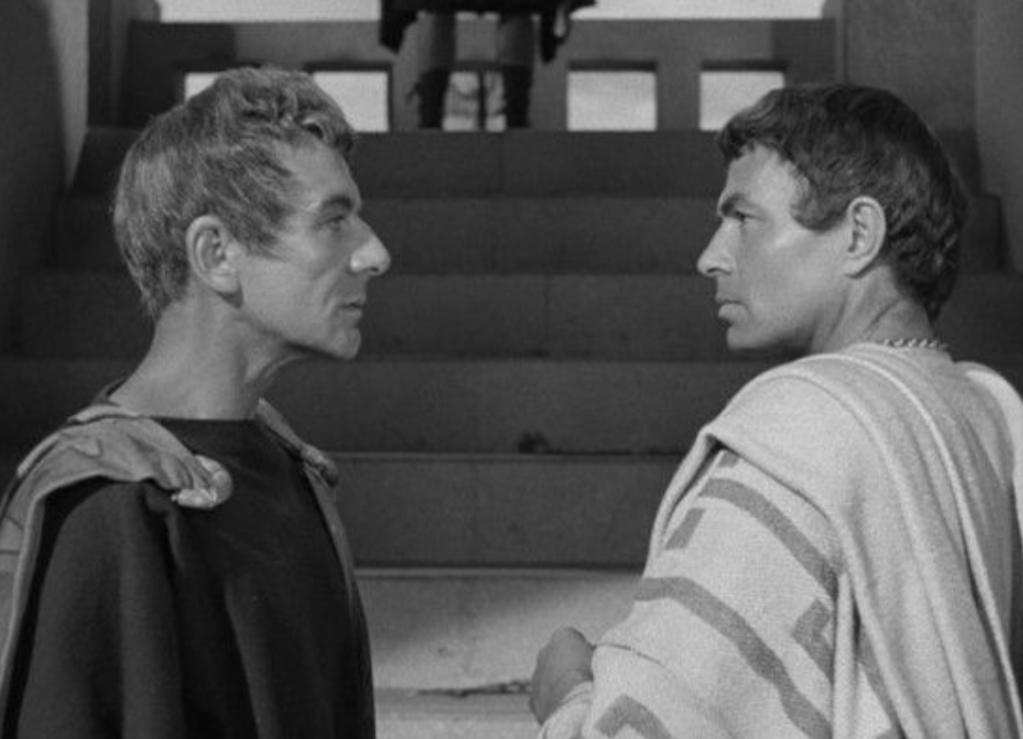
Brutus continues this treachery by undertaking a powerful position in the furtherance of the plot, serving as an inquisitive force in the conversation with Casca. By doing so, Brutus takes an active role in this coup. Although he does shortly thereafter exit the scene, his tacit commitment to the plan is overtly recognized and acknowledged for all to see. I think that the reason why this is meaningful in terms of Shakespearean commentary has to do with the hierarchical politics of old world power brokering, with the so-called band of Romans attempting to outmaneuver each other for eventual control in the ensuing chaos. There is an inherent power struggle in every conversation focused on committing treason of the highest order, so I think it makes sense to see Brutus establishing himself as a driver of this movement by being the person asking the questions, even though he was charmed by Cassius into taking physical action.
Act II, Scene I provides a glimpse into the Macbethian madness going through Brutus’s head. The opportunity to cement his legacy into the history of Rome is most likely the cause of this chaotic breakdown, which is quickly transformed into a realization of what might be the most wise political truth: when people feel the need to cover their faces to express their political will, they are conspirators not heroes. I will try to take up as little space as possible making an Antifa reference here. This realization of a truth is quickly followed by the gathering of the Romans, who begin to negotiate in as close a simulation of Roman politics as one will find in today’s world. Again, we see Brutus harness political power to his advantage, in subtle ways such as hosting the meeting at his residence. This could be compared to the ways in which the House and Senate would bicker over where joint meetings would be held, with the key takeaway that event location should never go unnoticed. In a parallel to negotiations in modern politics about staffing concerns, Brutus makes clear his opposition to the presence of Cicero in the plot. At first, there seems to be a lot of support for adding the man but as soon as Brutus speaks up and voices his concerns, he is supported by elders Cassius and Casca. The result is that the idea is promptly rejected. Cicero is only mentioned again in Act IV, Scene III when Brutus announces that he is dead. This is what power looks like.
Returning to the meeting of the Romans, Cassius and Brutus debate whether or not Mark Antony should also be killed. In this exchange, Brutus gets his way by articulating the importance of optics when it comes to this operation. The genius in this argument flows from its foresighted understanding of how their countrymen would react to a plot that took down both Julius Caesar and Mark Antony. Brutus is capable of exerting power in part because he has the foresight to imagine the consequences of an action, which is contemporarily very relevant to the concept of game theory in political decision making, something I was very lucky to learn about with Hoover Fellow Bruce Bueno de Mesquita last Spring. In our current age of governance, especially in the realm of international relations and militarism, many people attempt to harness their power in a similar way to appeal to the pathos of their audience by painting their struggle as one of a duality of good and evil. The result throughout the course of history has generally been a doubling down of commitment to the cause undertaken, and this time the sedimentation of their collectivized legacy as the force for good in this coup is no different.
The plot comes to fruition, and with his last words Julius Caesar iconically makes note of Brutus’s presence before crumpling to his death. Immediately, different interests bluster to the surface until the group coalesces around Brutus for direction. His guidance, to wash their swords and hands in the blood of Caesar is heeded and with this act he is transformed into the face of this political front. This call to action affirms to all involved that he will be their champion at the tip of the conspiratorial spear.

As the Romans prepare the funeral of Caesar, Brutus exerts his will as the leader to allow Mark Antony to attend and to give a speech after him. This was a controversial usage of power, but his unquestionable status enabled his decisions to go unchecked with eventually devastating results. As we know, just because somebody is making the decisions does not mean they are necessarily in control. Since Antony’s speech inspired such a groundswell of support, Brutus was quickly left reacting to the fallout of his flawed plan. Although Brutus was successful at herding his flock of co-conspirators through his personal entrenchment into the heart of the scheme, his ability to persuade the masses of his position were simply ineffective when compared to that of Mark Antony. Altogether, I think that the example of Marcus Brutus provides readers with a powerful understanding of the shortcomings of aristocratic power and how political forces can struggle in varied forms that can iterate through competitive elections as seen in our experience or through brutish acts of violence.
Keeping Secrets for the National Security States of America
Proximity to power is intoxicating. The desire to gain power leads people to run for political office or to help others do so. At the base level of politics, the allocation of government spending by a township in line-item budgets is the source of secrecy through misdirection. If you want your kids shoveling the snow…

UFO at Butler, PA Rally on 7/13/2024?
This conspiracy theory seems absurd, but the purpose of this article is to demonstrate the evidence that exists to claim that the assassination attempt made against President Donald Trump was filmed or witnessed by some form of an advanced technological system that flew by the Butler Farm Show in Butler, Pennsylvania on the day that…
DSNET: Revolutionizing Secure Teleconferencing in the Cold War Era
Introduction: During the Cold War era, when secure communication was of paramount importance, the Defense Communications Agency (DCA) introduced the Defense Secure Network (DSNET). DSNET marked a significant milestone in the field of secure teleconferencing, providing a robust and reliable platform for government officials and military personnel to communicate securely. This article explores the features,…
 American Political Theorist